How Modern School Libraries Are Transforming Learning
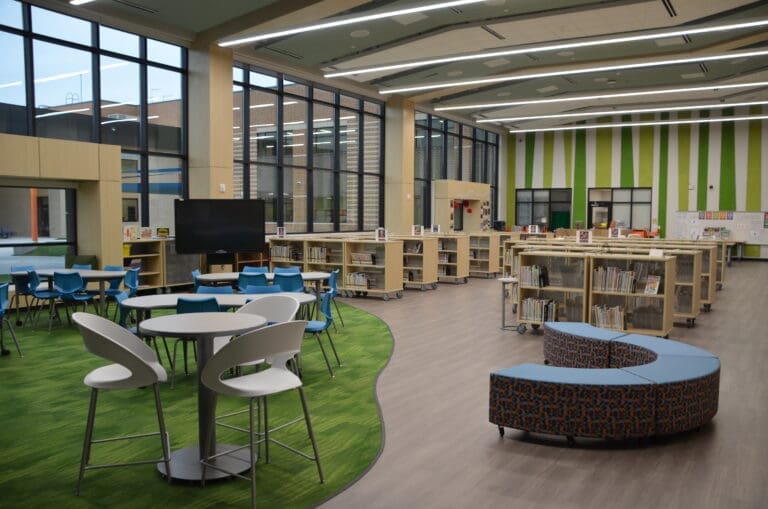
The school library is so much more than it used to be.
The old image of silent rows, towering shelves, and the ever-present “shh” feels like a relic. Today’s school libraries are being reimagined as the heart of the campus: collaborative, flexible, tech-integrated, and designed around how students actually learn. They buzz with discussion and creativity, and support everything from quiet independent reading to hands-on STEM projects — sometimes all in the same room, at the same time.
This transformation didn’t happen overnight, and it’s about much more than aesthetics. Driven by shifts in pedagogy, research on learning environments, and the evolving role of the school librarian, the modern school library is a fundamentally different space than it was even a decade ago.
At Lone Star Furnishings, we’ve had a front-row seat to this evolution across Texas school districts. And as we head to the Texas Library Association Annual Conference, we wanted to share what we’ve been learning — because the decisions districts make about their library spaces have real, lasting impacts on students.
Here’s what you need to know about the ideas reshaping school libraries today.
The most significant conceptual shift in school library design over the past two decades is the move from library to learning commons. As education scholars and designers have noted, schools around the country are transforming their libraries “from silent temples to hold collections of books and reference materials into multi-use learning commons spaces” — hubs of creativity and idea exchange that serve the full range of how students learn today.
Source: Smith System, “Learning Commons: How Technology is Changing 21st-Century Library Design” (smithsystem.com)
The traditional model that dominated from the 1950s through the 1990s emphasized individual study, with rows of uniform tables, towering stacks, and clearly defined quiet zones. Those spaces were built around a single activity: silent reading and research using physical materials. Today’s model recognizes that “learning is inherently social” and that students need environments that support animated discussion, multimedia collaboration, and peer-to-peer learning — not just quiet compliance.
Source: EDspaces, “The Next Gen K-12 School Library: 10 Essential Design Strategies” (ed-spaces.com)
And printed books? They’re still important — but they no longer need to consume an entire space. The shift frees up square footage for the kinds of active, dynamic learning that prepares students for the world beyond the school walls.
American Libraries Magazine’s 2024 Library Design Showcase put it well: libraries have evolved “from places devoted strictly to scholarship and materials collection to true third spaces, where diverse communities come together to congregate, learn, and grow.” That language — ‘third space’ — is worth sitting with. Libraries have become community anchors, places that belong to students in a way that classrooms sometimes don’t.
Source: American Libraries Magazine, “2024 Library Design Showcase” (americanlibrariesmagazine.org)
One of the most practical concepts in modern library design is also one of the most misunderstood: flexibility doesn’t mean one giant open room where everything happens everywhere. It means intentional zoning — designing distinct areas within the library to support distinct types of activity.
Most educators and designers now describe the modern K-12 library as containing at least three core zones: a collaborative zone for group work and active discussion, a social zone for lighter interaction and community, and an individual/quiet zone for focused study and independent reading. High-performing libraries often add to this: a makerspace or STEAM zone for hands-on creation, a tech/media production zone for podcasting, video production, or digital work, and a presentation or instruction zone for teacher-led lessons and workshops.
What makes zoning so powerful is that it allows the same four walls to serve very different students doing very different things at the same time — without chaos. Soft materials, strategic furniture placement, acoustic panels, and rugs can help define zones naturally, managing sound and circulation without requiring rigid architectural separation.
A 2024 piece from 3 Oaks Group on learning commons transformation captured the research well: “Flexible learning spaces, like those in Learning Commons, have shown a 32% increase in student engagement.” While individual studies vary in their methodology, the body of evidence consistently points in the same direction — when students have agency over where and how they work, they engage more deeply.
Source: 3 Oaks Group, “Inspiring Trends: Transforming Outdated Commons and Libraries” (3oaksgroup.com)
Age-appropriateness matters here, too. Effective school library design must account for the dramatic developmental differences between a kindergartener and a high school senior. A reading nook with floor cushions and low shelving that delights an elementary student is a very different design consideration than a high-top collaborative table with power access for a high schooler working on a research project.
The best library renovations and redesigns take a holistic view: What kinds of learning happen here? Who uses this space and when? What does each type of activity need in terms of furniture, acoustics, lighting, and layout? The zone structure flows from the answers to those questions — not from a catalog.
If zoning gives a library its strategy, furniture gives it its ability to execute that strategy. And the research on flexible furniture — seating and surfaces that can be reconfigured, moved, and adapted — is substantial and consistent.
A 2022 study published in the Journal of Learning Spaces found that nearly 80% of respondents indicated flexible seating had a positive effect on their learning experience across four key dimensions: movement opportunity, comfort, anxiety and restlessness, and focus and engagement. Students in flexible seating environments also reported finding it easier to collaborate with peers and more readily able to engage in a variety of classroom activities.
Source: Journal of Learning Spaces, Vol. 11(2), 2022 — “An Examination of Flexible Seating in Higher Education” (files.eric.ed.gov)
Another strand of research, published in PMC (National Institutes of Health), found that flexible seating contributes to the development of personal skills including self-reliance, self-regulation, and problem-solving — and can have positive effects on attention, motivation, engagement, and task-appropriate behavior.
Source: PMC / Frontiers in Psychology, “Influence of Flexible Classroom Seating on the Wellbeing and Mental Health of Upper Elementary School Students” (pmc.ncbi.nlm.nih.gov)
For students who struggle with traditional static seating — including those with ADHD or other attention differences — the benefits can be even more pronounced. One frequently cited study found that students using alternative seating went from being in-seat approximately 45% of the time and on-task only 10% of the time with standard chairs, to being in-seat 94% of the time and on-task 80% of the time with alternative seating options.
Source: Fedewa & Erwin (2011), as cited in Noble+Eaton, “Think Outside the Chair: How Flexible Seating Boosts Student Engagement” (nobleandeaton.com)
What does “flexible” actually look like in practice? EdTech Magazine described a clear picture from real school renovations: comfortable, collaborative furniture like chairs and tables with dividers that allow students to work alone, in pairs, or in small groups, but that can also be moved easily to create small pods. Mobile tables on casters. Adjustable-height surfaces. Soft lounge seating for reading areas. Cushioned options for students who benefit from movement while seated.
Source: EdTech Magazine, “What Does the Modern Library Look Like in K-12 Schools?” (edtechmagazine.com)
One important nuance: furniture enables pedagogy, but it doesn’t replace it. The research on flexible seating consistently notes that it works best when educators understand how to use it — when students have some guidance on choosing seats based on what they’re trying to do, and when the furniture choices are intentional rather than random. A library full of varied seating with no thought given to flow or zoning is just… a cluttered room. The furniture should serve the learning design, and the learning design should drive the furniture.
The national trends in library transformation are very much alive in Texas. The Texas Association of School Librarians (TASL), through its work with TLA, has been advocating for librarians as teachers who are “essential components of a robust educational system” — and for library spaces that reflect that expanded role.
Source: Texas Library Association, TASL Division (txla.org)
The 2025 TLA Annual Conference, themed “Library Renaissance: Our Quest for Renewal,” brought library professionals from across the state together to reimagine the role of libraries in a shifting world — exploring innovative programming, new service models, and what it truly means to lead a library renaissance in a period of rapid change.
Source: Texas State Library and Archives Commission, “Library Renaissance: 2025 TLA Annual Conference Recap” (tsl.texas.gov)
Across Texas school districts, librarians are taking on expanded roles as instructional partners, technology leads, and curriculum collaborators. As one Irving ISD librarian put it, the job has evolved far beyond checking out books — today’s school librarians are advocates for their students, curators of resources, and often the go-to person for any technology help on their campus.
Source: ATPE, “The Future of School Libraries” (atpe.org)
That evolution in role demands an evolution in space. A librarian who leads lessons, facilitates collaboration, and supports digital literacy needs a library that can do all of those things — not one designed around a checkout desk and stacks.
Texas school districts of all sizes are grappling with how to make the most of their library spaces, often within tight budgets. The good news is that many of the most impactful changes don’t require a full renovation. Rearranging existing furniture to create zones, adding mobile seating or a few key pieces, updating lighting — these targeted investments can meaningfully change how a space feels and functions for students and librarians alike.
The transformation of the school library into a learning commons isn’t a trend — it’s a response to how students actually learn, backed by research and driven by the educators who work with students every day. The spaces we create for students send a message about what we value. A library that offers one type of chair and one type of table says: we expect everyone to learn the same way. A library with zones, varied seating, and flexible furniture says: we designed this for you.
Furniture is not the whole answer — it’s the enabler. The right chairs and tables, thoughtfully arranged in service of a clear vision for how the space will be used, can unlock a library’s potential to be exactly what today’s students need: a place to read quietly, work collaboratively, create, discover, and belong.
At Lone Star Furnishings, we’ve been helping Texas school districts make that vision a reality since 2008. We work alongside districts from initial needs assessment and space planning all the way through delivery, installation, and beyond — because a great library isn’t just a purchase, it’s a partnership.
If you’re heading to TLA this year, we’d love to connect. Come find us at our booth and let’s talk about what’s possible for your library.
American Libraries Magazine – 2024 Library Design Showcase: americanlibrariesmagazine.org
EDspaces – The Next Gen K-12 School Library: 10 Essential Design Strategies: ed-spaces.com
EdTech Magazine – What Does the Modern Library Look Like in K-12 Schools?: edtechmagazine.com
PMC / Frontiers – Flexible Classroom Seating & Student Wellbeing: pmc.ncbi.nlm.nih.gov
Noble+Eaton – Think Outside the Chair: nobleandeaton.com
3 Oaks Group – Inspiring Trends: Transforming Outdated Commons and Libraries: 3oaksgroup.com